Last updated November 18, 2026




Free written scope consultation - allowances, timeline, and change-order rules on paper before a single trade is scheduled
Driveway & Pavers Troubleshooting in Sunrise Manor: Common Problems and How to Fix Them
If you’re refilling the same sunken section of your paver driveway for the third time, you haven’t fixed the problem. You’ve been treating the symptom of a base that was never compacted to Nevada’s soil conditions. Most paver failures in Sunrise Manor trace back to one of three root causes: a base that gave way under the load, polymeric sand that washed out of the joints, or efflorescence pulling white mineral haze up through the surface from alkaline groundwater. Each has its own repair path, and mixing them up is how homeowners end up paying for full demo and reinstall when a targeted fix would have held. We’ll walk you through how to tell these apart, what our local caliche soil does to a driveway base, and when a repair is honest and when it isn’t.
Quick Answer
Most paver driveway problems in Sunrise Manor come down to base failure, sand washout, or efflorescence, and each is diagnosed by watching how the damage progresses: sinking that spreads points to the base, weeds and loose joints point to the sand, and white haze that returns after cleaning points to efflorescence. Spot repairs work for isolated sand and mineral issues, but any sinking or rocking over a wide area needs the section lifted, the base rebuilt to depth, and the pavers releveled.
Styles & brands we work with
- Kitchen remodeling
- Bathroom remodeling
- Home additions & ADU
- Roofing
- Windows & doors
- Driveway & pavers
- Fence
Table of Contents
- How to Diagnose What’s Actually Wrong With Your Paver Driveway
- Why Caliche Soil Creates Drainage Traps Under Sunrise Manor Driveways
- Efflorescence vs. Staining: What That White Haze Really Is
- When a Spot Repair Works and When You Need to Lift the Section
- How to Clean, Re-Sand, and Re-Seal Without Damaging the Joints
- Cracked, Chipped, and Loose Pavers: Replacement and Repair
- Drainage, Slope, and Standing Water Problems
- Preventing Future Paver Trouble in Sunrise Manor
How to Diagnose What’s Actually Wrong With Your Paver Driveway
The fastest way to save money on a paver repair is to correctly identify what failed. The three big culprits look different once you know what to look for, and each tells you something different about what’s happening underneath.
Base failure shows up as progressive sinking. A section that was flat two years ago is now dipping at the edges of the driveway, or a rut is forming where car tires sit. It gets worse each season, and the dip spreads outward. Press down on the paver; if it rocks or sounds hollow, the material under it has shifted and lost contact with the paver.
Polymeric sand failure looks different. You’ll see weeds sprouting through the joints, the sand line sitting low or gone entirely, and loose pavers that shift underfoot without any visible sinking of the surrounding area. Water finds those open joints fast.
Efflorescence is the white, chalky haze that appears on the paver surface, often after a wet period. It wipes away and comes back. It’s a mineral deposit migrating up from below through the pavers and joints.
Do this walkthrough before you call anyone:
- Walk the whole driveway in flat shoes and note every spot that rocks, sounds hollow, or dips.
- Look at the joints. Bare or low sand plus weeds equals a sand problem.
- Look at the pavers themselves. Hairline cracks or chipped corners are paver-level damage, not base.
- Hose a small area and watch where the puddles form. Water pooling in the same spots points to a slope or drainage issue.
- Wipe a white patch with a dry rag. If it disappears and returns a few weeks later, that’s efflorescence.
Knowing which problem you actually have is what saves the thousands in demo and reinstall that get billed when the wrong fix is applied. Our driveway & pavers work in Sunrise Manor starts with exactly this kind of diagnosis, and it’s a conversation worth having before any shovel hits the ground.
Why Caliche Soil Creates Drainage Traps Under Sunrise Manor Driveways
Sunrise Manor sits over some of the hardest, most stubborn soil you’ll find in the valley. Caliche is a natural layer of calcium carbonate that forms in desert soils when water carrying dissolved minerals evaporates and leaves the minerals behind. Over years, that cement-like crust hardens into a barrier that water simply can’t drain through. A paver driveway built on top of it is essentially sitting on a shallow bowl.
Why does that matter for the pavers? Two reasons. First, water that soaks down through the joints hits the caliche and stops. It sits in the base material, softening it and pushing fines out sideways. Second, that trapped water is the perfect delivery system for the alkaline minerals that cause efflorescence. The base that should be a firm, well-draining support layer becomes a sponge instead.
The fix isn’t a mystery. A base that clears the caliche layer, or that drains reliably through and away from it, holds up. That means:
- Excavating deep enough to remove or break through the caliche layer at the surface, not just skimming the topsoil.
- Laying a properly graded, compacted aggregate base in compacted lifts rather than one thick dump.
- Compacting each lift to real density with plate equipment, testing density as you go, not eyeballing it.
- Setting a drainage plan that moves water off the driveway to a low point or landscape, not into a trap beneath it.
This is the part most quick paving jobs skip. A crew that excavates only a couple of inches and lays pavers on native dirt will give you a driveway that looks perfect on install day and starts sinking the first winter it takes water. If you’ve already been told that “harder ground means you don’t need a base,” that’s the source of the failure returning every spring. Sunrise Manor’s ground is not asking for less base; it’s asking for more.
Efflorescence vs. Staining: What That White Haze Really Is
The white haze on pavers is a mineral salt deposit called efflorescence. Water carrying dissolved calcium compounds wicks up through the pavers, reaches the surface, evaporates, and leaves those salts behind as a white powder. It’s cosmetic in the vast majority of cases, not a sign your pavers are rotting from the inside, though it does tell you water is moving through the system more than it should.
Tell efflorescence apart from other stains this way:
- Efflorescence: white, powdery, wipes off with a dry rag but returns after a wet cycle, usually worst on new pavers and during the cooler, damper months.
- Hard water or irrigation staining: a grey-white ring where sprinklers hit, doesn’t wipe off easily, sits on the surface like a film.
- Rust or iron staining: orange or brown streaks, often near a metal object, fertilizer, or a paver containing iron.
- Organic staining: dark or green-black patches, usually where shade holds moisture.
What most people get wrong is reaching for the strongest acid product on the shelf. Muriatic acid used on fresh efflorescence can drive the salts back into the paver and can also degrade the surface. What actually works is patience and the right sequence:
- Let the pavers cure. On new installations, efflorescence fades on its own if the water source is reduced.
- Dry-brush the surface to remove loose powder.
- Fix the water source: repair joint gaps, check the slope, redirect irrigation and downspouts away from the pavers.
- If haze persists, use an efflorescence remover made for concrete pavers, following the label dilution, and never use a pressure washer to blast it into the joints.
- Do not seal over active efflorescence. A sealer traps the salts under the film and drives them out at the edges, which looks worse.
Efflorescence that keeps returning points to a wet base. In Sunrise Manor the caliche layer is often the reason. Treating the surface without addressing why the water is trapped will keep the white haze coming back, whatever cleaning product gets used.
When a Spot Repair Works and When You Need to Lift the Section
Spot repairs are honest fixes when the failure is contained. They’re a waste of money when it isn’t. Here’s the line between the two.
A spot repair makes sense when:
- A single paver is cracked or chipped from a dropped load or a heavy vehicle, and the surrounding surface is flat and stable.
- One small area of joints has lost its sand but the pavers aren’t rocking and the surface isn’t dipping.
- Efflorescence is confined to a small patch and the base under it is draining correctly.
- A paver is stained from an isolated spill and needs only cleaning or replacement.
A full section lift is the only honest fix when:
- Sinking is progressive and spreading. If it gets worse year after year, the base is not holding and no amount of patching the top will stop it.
- Several pavers rock together and the joints between them have opened.
- Water pools in a wide area after every rain and the base is soft underneath.
- A tree root or buried utility has displaced the base under a section.
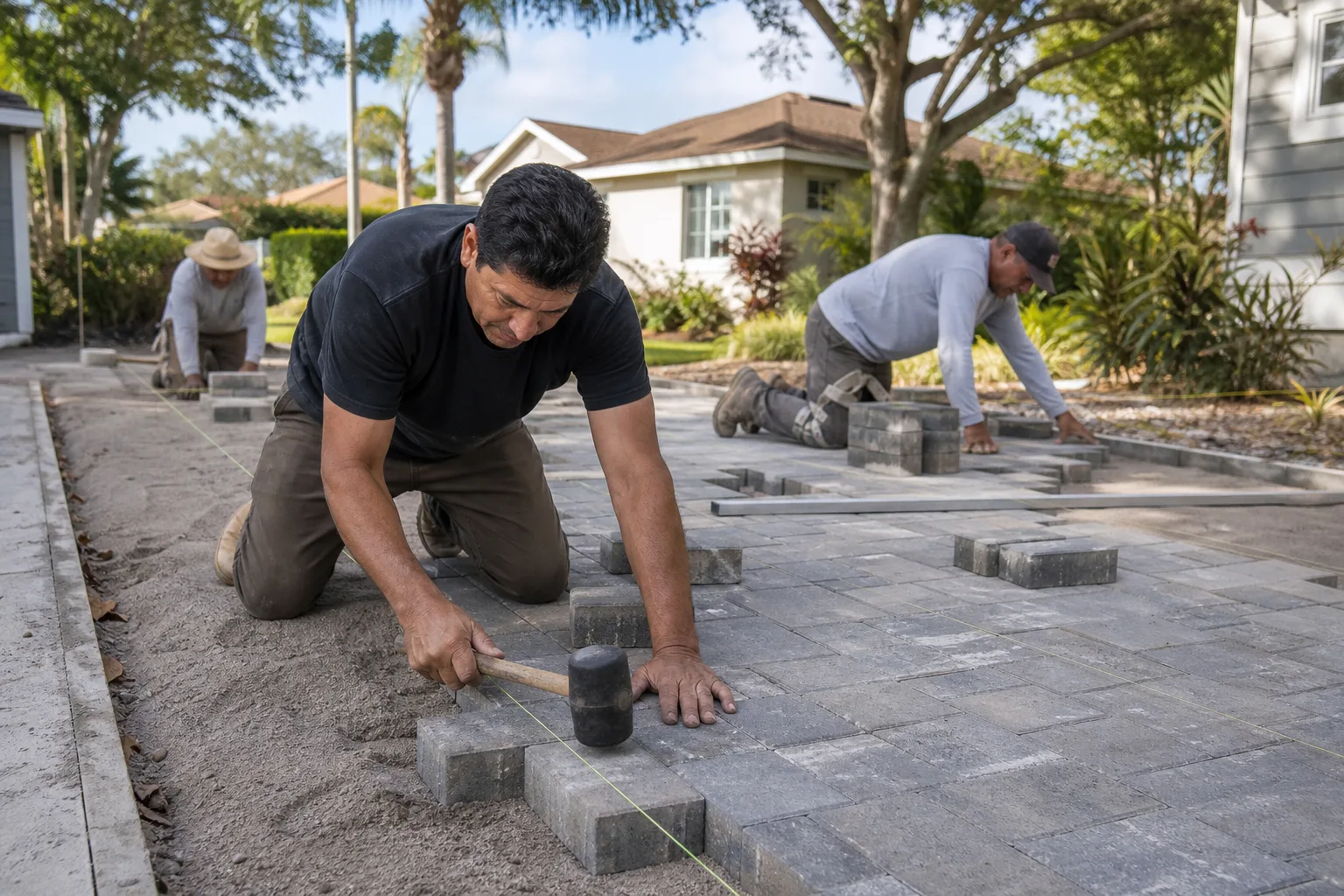
When a section does need to be lifted, the right approach is to remove the pavers carefully and set them aside, dig out and rebuild the base to proper depth, recompact in lifts, reset the pavers on the new base, and re-sand the joints. That buys the section back, keeps the existing material, and matches the finish to the rest of the driveway. What it doesn’t do is require tearing up the entire driveway just because one section failed. Our technicians have up to 11 years of experience reading exactly this difference, and we won’t quote a full demo when a targeted rebuild will hold.
How to Clean, Re-Sand, and Re-Seal Without Damaging the Joints
Pressure washing is one of those jobs that’s easy to do badly and expensive to fix. Blast the nozzle into the joints at a sharp angle and you’ll wash out the polymeric sand and can chew up the paver edges and even the cementitious surface layer. Done right, though, it’s the foundation of keeping a paver driveway looking and performing at its best.
What we do on a paver driveway in Sunrise Manor, and what you can ask any contractor to follow:
- Start with a dry sweep. Clear debris and pull weeds before any water gets involved.
- Use a fan tip, not a pinpoint nozzle. Wide spray, nozzle kept moving, angle at roughly 30 degrees to the surface so force shears across the pavers instead of driving into the joints.
- Work on a section at a time. Wash, inspect, move on. Don’t saturate an area and leave it standing in water.
- Let the pavers dry completely. That usually means more than a day, depending on weather, before any re-sand or sealer goes on.
- Re-sand with the right product. Polymeric sand designed for paver joints is spread over the surface, worked into the joints, compacted, and then set with a light mist per the manufacturer’s instructions. Sand that’s just dumped and swept leaves voids that wash out.
- Choose the sealer for the surface and climate. Breathable sealers are generally more forgiving in a hot, dry climate than heavy film formers, and matching the sealer to the paver brand and finish protects the material warranty.
One warning on warranties. Some paver manufacturers specify the cleaner, sand, and sealer that keeps their warranty valid, and using a generic acid cleaner or a non-compatible sealer can void coverage on the material. When we install with Cambridge Pavers or Techo-Bloc, we follow their care instructions and can tell you which products match. If your driveway was installed by someone else, find the paver brand (often printed on the side of a paver in a tucked-away corner), and check with the manufacturer before applying a cleaner or sealer.
Cracked, Chipped, and Loose Pavers: Replacement and Repair
Not every paver problem is a base problem. Sometimes the pavers themselves take damage. A cracked paver is often a load issue, a dropped item, or a paver that was laid on an uneven bed and took the flex on its own. A chipped corner might be a mower edge or a heavy wheel. Loose pavers can be a sand issue, or the edge restraints giving way.
What to check, in order:
- Is the crack in one paver or several in a line? A line of cracks points to a base or load issue below; a single crack points to impact.
- Does the paver rock? If yes, the bedding or base under it has moved, and replacing just the paver won’t hold.
- Are pavers at the driveway edge spreading outward? That’s usually missing or failed edge restraint, which lets the whole field loosen.
- Are pavers shifting where a car parks? Heavy point load plus a soft base plus a caliche drainage trap is a common Sunrise Manor combination.
Replacing a single damaged paver is a quick, reasonable repair when the pavers around it are tight. The old paver is lifted, the sand bed is leveled, and the new one is set in and re-sanded. The trick is matching the color and texture. Paver runs vary, and a replacement from a different batch may look slightly different, which is why we recommend keeping a few spare pavers from every install for future repairs. If your driveway was laid with Oldcastle or Cambridge Pavers, a matching replacement is usually findable with the brand and profile in hand.
Drainage, Slope, and Standing Water Problems
Standing water after a rain is the clearest sign a paver driveway has a drainage problem, and left alone it accelerates every other failure. Water sits in the joints, pushes into the base, and drives efflorescence up. In Sunrise Manor, the flat, hard caliche underneath makes this worse because the water has nowhere to go but sideways and up.
What causes it:
- Insufficient slope. Driveways need a consistent fall away from the house and toward a low point that drains. A flat spot holds water.
- A low spot from base settlement. This is the most common cause once a paver driveway has aged. The dip is where the base gave way.
- Downspouts and irrigation dumping onto the pavers. Roof water routed at the driveway finds the joints.
- No edge restraint or failed edge. Water gets under the field from the side.
Correcting drainage usually means reshaping the grade and rebuilding the base under the affected area with the proper slope. When a driveway is small and the door threshold is low, a channel drain or a French drain to a landscape low point is sometimes the honest answer. That’s a conversation to have with a contractor who reads the whole site, not a job to solve with a coat of sealer and hope.
Preventing Future Paver Trouble in Sunrise Manor
Most paver failures we see could have been prevented at the install stage. The difference between a driveway that lasts and one that sinks is base preparation, and no cosmetic step makes up for it.
- Base depth and compaction. Excavate to the right depth for the load (residential driveway versus footpath), use well-graded aggregate, and compact each lift. Native soil is not a base.
- Match the base to the soil. In Sunrise Manor, that means anticipating caliche and either breaking it up or designing drainage around it.
- Set edge restraints properly. A paver field without restraint spreads outward. Restraints and a proper edge are what keep the field tight.
- Follow the paver maker’s install spec. Brands like Techo-Bloc and Cambridge Pavers publish installation guidelines, and following them keeps the material warranty valid. Ask your contractor which spec they’re building to.
- Get the water plan right. Slope, drains, and redirecting downspouts and irrigation are part of a complete job, not an afterthought.
- Re-sand and re-seal on schedule. Joints lose sand over time, and replacing it protects the base and the pavers.
If you’re installing a new paver driveway rather than repairing one, the same principles apply, and getting the base and water plan right the first time is what makes the difference. It’s also worth planning the driveway alongside the rest of the property’s hardscape so materials, colors, and drainage fit together. When we install a driveway with Quikrete base products or set it with Techo-Bloc pavers, the goal is a driveway that doesn’t need troubleshooting five years in. One contractor from the driveway to the roofline is what makes that coordination realistic, and it’s why clients often plan a fence installation or a landscaping change at the same time, so drainage is designed once and built once.
Common Mistakes to Avoid
- Re-sanding and calling it a fix. Fresh sand hides the symptom for a season but doesn’t address a base that’s already failed. If pavers rock underneath, the base is the problem, not the sand.
- Pressure-washing the joints on purpose. Blasting water into the joints to clean them is how polymeric sand voids open up. Wash the pavers, not the joints, and re-sand afterward.
- Sealing over efflorescence. Trapping mineral salts under a film pushes them out at the edges and looks worse than before. Reduce the water source and let the haze go away before sealing.
- Skipping the caliche check. A base that sits on top of hard caliche traps water. Excavation depth and drainage design matter more in Sunrise Manor than in many places, and shortcutting them guarantees trouble.
- Laying the new paver on a soft bed. Replacing a single paver on uneven sand with no compaction means the same paver rocks again next month. Level and compact the bed first.
- Ignoring the edge. Pavers spread outward when restraints fail. Missing or broken edge restraints need fixing before the field in the middle gets reset.
- Mismatching cleaners and sealers. Some cleaners and sealers void a manufacturer’s material warranty. Check the paver brand’s care guide, or ask us about it.
See the difference
 Before
 After
 Before
 After
 Before
 After
When to Call a Professional
Many paver problems are worth trying to diagnose yourself first, and the walkthrough in this guide is meant to help. But some repair paths carry real risk to the driveway structure, the drainage around your home, and the material warranties. Call a professional if you have sinking that’s spread across more than a small area, water pooling against the house foundation, pavers rocking along a whole section, or base failure under a family vehicle. We also recommend a professional for full pressure-wash and re-sand work where the base is uncertain, and for any repair that touches an edge restraint. Sunrise Manor Construction offers free estimates in Sunrise Manor. The written line-item estimate sets the price, we pull permits where required, and we can walk you through options at every budget tier. Call (833) 516-4965. We answer 24/7. Fast dispatch from 7am to 7pm, Sunday through Friday.
Frequently Asked Questions
Repair cost depends on whether the job is a spot replacement, a re-sand and re-seal, or a rebuilt section, and the range we quote is per job based on an on-site measure, not a per-square-foot rate. A single paver replacement sits at the low end, a full pressure-wash, re-sand, and seal sits in the middle, and a section lift and base rebuild is the larger job. The written line-item estimate sets the price, and there are no change orders if scope doesn’t change. Call (833) 516-4965 for an exact quote from a free estimate.
A paver spot that keeps sinking has a base problem, not a sand problem. The base under that area is soft, undercompacted, or draining into a caliche trap, so once water works in, the support gives way and the pavers dip. Re-sanding or adding material on top won’t fix it; the section needs to be lifted and the base rebuilt to the right depth. Call (833) 516-4965 to schedule an inspection.
White haze on pavers is usually efflorescence, a cosmetic mineral deposit drawn up by water moving through the pavers, and it’s not structural. It tends to come and go with wet and dry cycles, especially in the first year after install. The right treatment is dry-brushing, reducing the water source, and a paver-safe efflorescence remover if it persists. Don’t seal over active efflorescence. Call (833) 516-4965 if it keeps coming back.
You can, but the results depend entirely on technique. Use a fan tip, keep the nozzle moving at a shallow angle, never blast into the joints, and let the pavers fully dry before spreading polymeric sand and setting it per the manufacturer’s instructions. Check the paver brand’s care guide first, because some cleaners and sealers void the material warranty. If you’d rather not risk it, call (833) 516-4965 to book a wash, re-sand, and seal.
No. We scope the work from an on-site inspection, provide a written line-item estimate, and the price we quote is the price you pay, with no change orders unless you add scope. If you ask for a new paver profile or a different sealer, we’ll quote that change up front. Call (833) 516-4965 for a free estimate.
Most municipalities require a permit when a driveway or hardscape changes the way stormwater drains or alters the property’s impervious surface, and we’ll pull the permit and handle the inspection where required. We confirm the local requirement on site before starting, so you’re not the one chasing paperwork. Call (833) 516-4965 to schedule an estimate.
The Bottom Line
If your paver driveway is failing, the very first job is to figure out which failure you’re looking at. Progressive sinking means a base problem. Weeds and low joints mean a sand problem. White haze that keeps returning means efflorescence and a water problem underneath. Solve the right one and you save the thousands that a mistaken full demo and reinstall would cost. In Sunrise Manor, caliche soil makes base depth and drainage the deciding factors. Our technicians have up to 11 years of experience diagnosing exactly these cases, and a free estimate is the quickest way to a straight answer.
Sunrise Manor Construction handles paver driveways and hardscape as part of a full-scope residential service that also covers fence installation, roofing, windows and doors, home additions & ADU, and kitchen and bathroom remodels. If your home’s next chapter includes a driveway rebuild, a new fence, or an addition, one contractor from the driveway to the roofline means fewer people to manage and a more coordinated result. We work with 50+ named brands across hardscape, roofing, and interiors, so we can match materials to the tier you choose. To talk through your project, call (833) 516-4965 for a free estimate, or visit Sunrise Manor Construction to see the full range of work we do.
Written by the team at Sunrise Manor Construction.